
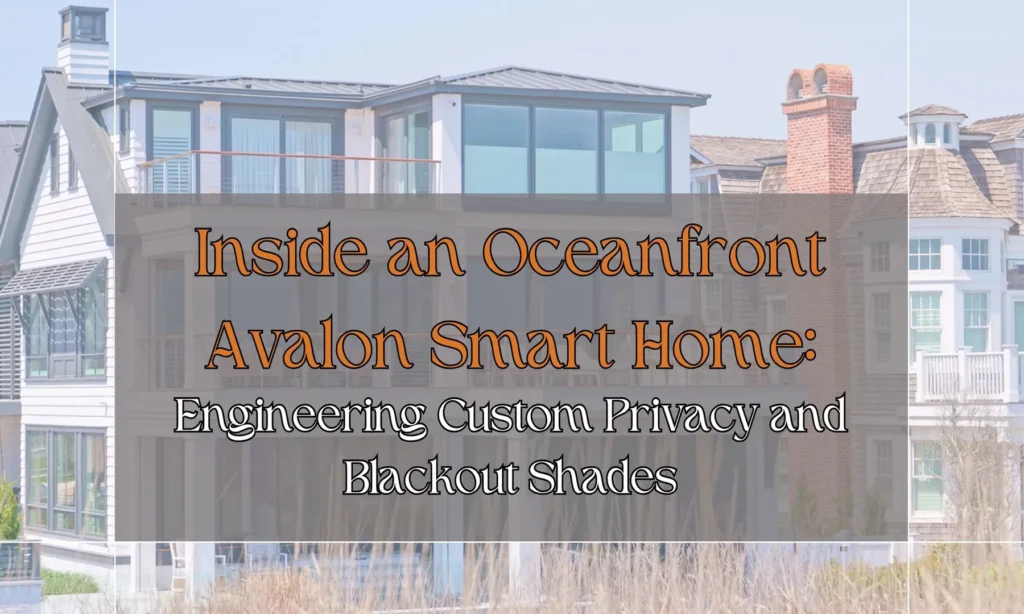
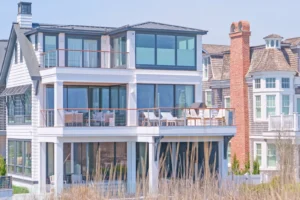
In an oceanfront home on Seven Mile Island, only the dunes separate it from the Atlantic. The view is the whole point — but on the ground floor and upper bedroom, so is the privacy problem. Anyone walking the beach has a clean sightline into the upper living spaces. Drapes work on the main floor, where the windows are tall and high and the dunes would mostly block the view, but on the ground floor and the third-floor primary bedroom, closing them for privacy would block the very view we wanted to preserve.
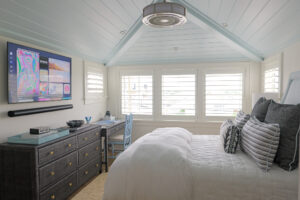
And then there was the blackout requirement — for the bedrooms, on shades long enough that no off-the-shelf roller would hold tension without gapping.
This is the project where Cooltronics engineered two solutions that didn’t readily exist.
Table of Contents
Project at a Glance
- Location: Oceanfront home, Avalon, NJ (Seven Mile Island)
- Client: Repeat Cooltronics client; full three-story integration
- The challenge: Preserve ocean views while blocking sightlines from the beach below — plus true gap-free blackout in the bedrooms
- The custom engineering: A bottom-up privacy shade built on Lutron Sivoia QS components, and a custom-fabricated carbon fiber roller for gap-free blackout shades at extended lengths
- Systems installed: Structured wiring & networking, Lutron HomeWorks lighting / shade / drapery control, Samsung Frame TVs, Samsung Terrace outdoor TV, indoor & outdoor audio (color-matched exterior speakers), Josh.ai voice control, Security by Private Eyes (cameras, smart locks, leak detection, 24/7 monitoring)
- Integrator: Cooltronics — serving Avalon and Seven Mile Island since 1984; Lutron Silver Integrator
An Oceanfront Avalon Smart Home
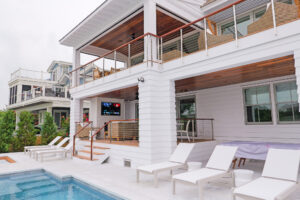
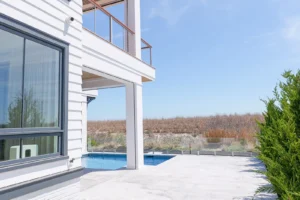
The home sits at the end of the block, the last property before the dunes — three stories of glass, wood, and ocean light. The clients are repeat Cooltronics customers, returning for a top-to-bottom project. That repeat-client decision is the part of the project we’re most proud of. They knew what we’d done. They knew what to expect – and because of that, they came back.
The scope of this build covered nearly everything we do: structured wiring and networking, Lutron lighting, drapery and shade control, indoor Samsung Frame TVs, a Samsung Terrace outdoor TV on the deck, indoor and outdoor audio with custom-painted exterior speakers, Josh.ai voice control, and integrated security and monitoring through our in-house Security by Private Eyes division. A project where every system was specified by the same team, designed to work together from the start, and serviced by technicians who know the whole house.
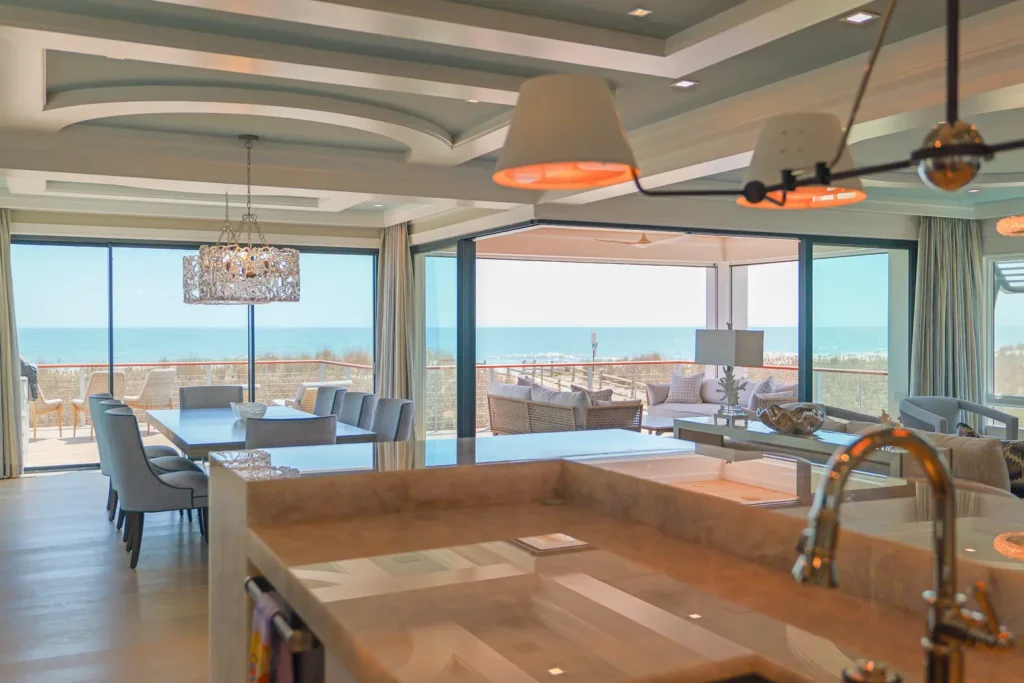
On the second floor — the main living level — Lutron-motorized drapes anchor the design. The windows up there are tall enough and high enough that drapes work beautifully: integrated, automated, controlled alongside everything else. They are part of the design vocabulary, not a workaround.
The engineering challenges came on the floors where drapes weren’t the right answer.
Two Problems No Catalog Could Solve
The view-vs-privacy problem. On the ground floor and third floor, the windows extend down into the zone where anyone walking the beach or the sidewalk can look straight in. Conventional top-down shades block the view first — exactly backwards for this home. Sheer shades let too much through at night. Smart glass is slow and doesn’t address the specific lower-portion-of-the-window issue. The homeowner asked a seemingly simple question: Can we keep the view from inside the house, but block the view from outside? Unfortunately, there didn’t seem to be anything immediately available to provide the solution.
The blackout problem. Separately, the homeowner needed full blackout shades for the bedrooms and certain ground-floor spaces. The catch: blackout shades fail the moment a light gap appears — along the sides, at the top, or anywhere a beam can leak through. And the shade lengths required for these particular windows were long enough that any standard aluminum roller tube would either flex under tension or droop slightly at the center. Either way, gaps. Either way, no blackout.
And on some windows, both problems coexisted. Certain openings needed both a bottom-up privacy shade and a full blackout shade — stacked in the same window pocket, controlled by the same Lutron system, operating independently of each other both mechanically and within the scene logic. Two shading systems, one window, no compromises.
Three engineering challenges. Three solutions designed around Lutron components, but built in-house.
Engineering Custom Lutron Shades for Oceanfront Home Automation
The Bottom-Up Privacy Shade
The design concept was straightforward to describe and difficult to build: a shade that rises from the sill rather than dropping from the header. Blocks exactly the lower zone that someone on the beach or sidewalk would look through. Leaves the upper portion of the window completely open to the view. Disappears into a custom sill housing when fully retracted.
The execution required reverse-engineering a Lutron system that was not designed to operate that way. We built the shades on Lutron Sivoia QS components — the high-end motorized shading platform – Cooltronics is a Silver Integrator certified to install — and designed custom mounts, a reverse-tracking system, and a sill-integrated housing to make the shades rise instead of drop. Lutron supplied the motor and control intelligence. We designed the mechanical envelope around it.
The advantage of building on Lutron rather than starting from scratch: the custom shades integrate seamlessly with the rest of the home’s Lutron lighting and drapery. They respond to scenes alongside every other shade in the house. They take voice commands through Josh.ai. They appear in the homeowner’s Lutron app exactly where you’d expect them to.
The Carbon Fiber Blackout Roller
The blackout shade requirement looked simple on paper. In practice, the engineering was, in its own way, more demanding.
A blackout shade fails the moment any light leaks through. Side gaps, top gaps, sag at the bottom — any of them defeats the purpose. And on shades of the length these windows required, a standard aluminum roller would deflect just enough under the weight and tension of the fabric to create exactly that kind of failure. Sag in the middle. Gaps along the edges. Light bleed.
The solution was a custom-fabricated carbon fiber roller tube. Carbon fiber has a meaningfully better stiffness-to-weight ratio than aluminum at long spans, which means the roller holds true across the full length of the shade with no measurable deflection. We specified the dimensions, sourced the fabrication to spec, and integrated the assembly into a Lutron motorized system.
The result was uniform, gap-free light blockage from edge to edge on shades that, on a conventional roller, simply wouldn’t have worked.
Making Both Coexist in the Same Window
The hardest piece of the engineering wasn’t either shade individually. It was the windows where both had to operate together.
A bottom-up privacy shade rising from the sill. A blackout shade dropping from the header. Same window opening. Both Lutron-controlled. Both operating independently — without mechanical interference between the two roller systems, and without their control logic stepping on each other in the home’s scene programming.
The solution involved a dual-pocket installation that physically separates the two roller assemblies in the window head and sill, and a Lutron scene structure that gives the homeowner clean independent control. “Evening — ocean privacy” runs only the bottom-up shades. “Goodnight” runs both, in sequence, in the bedrooms. “Movie” drops the blackouts in the media space without touching the privacy shades on the windows facing the dunes. Each scene can be set to do exactly what it should, and nothing it shouldn’t.
The exterior view from the dunes tells the story better than the description can. Privacy shade raised, the entire lower portion of the window reads as opaque. Privacy shade lowered into its sill housing, the window is fully open to the ocean from the inside.
The Rest of the System
The custom shading work tends to dominate the story, but it sits inside a complete top-to-bottom integration — every other system in the home designed and installed by the same team, by the same standard.
Structured Wiring and Networking — The Backbone
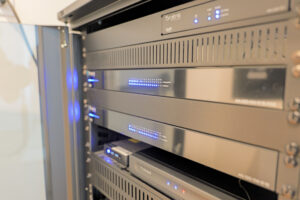
Every cohesive smart home starts with the wiring you can’t see. Cat6A throughout the home for data, fiber to the central rack for backbone speed, dedicated runs for AV, security, and control. Pre-wired during framing in coordination with the builder — the right time to do this work, before drywall makes everything ten times harder. Equipment lives in a conditioned room, organized and labeled so any technician who comes through in ten years can find what they need.
Learn more about structured wiring and networking.
Lutron Lighting, Shade, and Drapery Control
A Lutron HomeWorks system controls lighting, shading, and motorized drapery across every floor. Layered scenes for entertaining, evening wind-down, away, and sleep. On the second floor, the motorized drapes that anchor the main living level. On the third floor and ground floor, the custom shading systems described above. All of it controlled together from wall keypads, the Lutron app, or by voice.
Learn more about Lutron lighting and shade control.
Indoor and Outdoor AV — Designed to Disappear
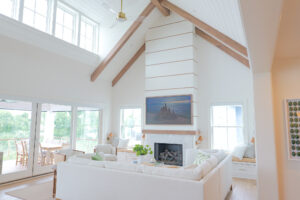
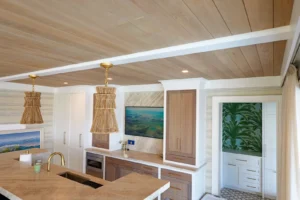
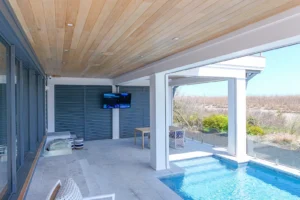
Samsung Frame TVs in the living spaces. When they’re off, they display artwork. When they’re on, they’re a premium entertainment display. Either way, they read as part of the room, not equipment hanging from a wall. A Samsung Terrace outdoor TV on the deck, rated for direct sun and coastal humidity. In-ceiling indoor speakers distributed across audio zones, and exterior speakers on the outdoor living area custom-painted to match the wood ceiling so the technology disappears into the architecture. You hear the speakers; you don’t see them.
Learn more about whole home audio and video.
Josh.ai — Concierge-Grade Voice Control
Josh.ai (The homeowner utilized the alternate name, “Nikola.” ) is a privacy-first AI voice assistant designed for luxury homes — it understands natural conversational commands (“close the ocean shades and bring the lights to thirty percent”), it works as the voice control center for the entire home, and it doesn’t send voice data to large cloud services. For households where privacy is a real consideration, that distinction matters.
Learn more about Josh.ai and home automation systems.
Security by Private Eyes — One Roof, One Team
Cooltronics’ in-house security division, Security by Private Eyes, handles cameras, access control, leak detection, and 24/7 monitored alarm service — fully integrated with the rest of the system. One company, one technician who knows the home, one phone number when something needs attention. For a seasonally-occupied oceanfront home, this matters: a leak detected at 3 a.m. in February goes to the same team that installed the system, not a national call center reading from a script.
Learn more about Security by Private Eyes.
What Oceanfront Avalon Homes Demand
Forty years of work on Seven Mile Island has taught us what oceanfront homes actually require. This project demonstrates four of those lessons in one place.
The view-vs-privacy tradeoff is solvable — but solving it takes the willingness to design around the catalog, not just specify from it. Most integrators install what’s available. Solving real problems sometimes means engineering what isn’t.
Coastal homes demand coastal-specific specification. Salt air destroys exterior speakers that weren’t built for it. Outdoor TVs not rated for sun and humidity fail within a season. Cabling, mounting hardware, and exterior equipment all need to be chosen for the actual environment they’ll live in. Cooltronics has been working on Seven Mile Island long enough to know what survives.
Second-home owners need remote-first design. Almost every Avalon home we work on is a second or third residence. The technology has to keep working when no one is on the island — leak sensors that alert before damage occurs, climate scheduling that pre-cools the house for arrival, security and cameras accessible from anywhere. These aren’t add-on features. They’re the design philosophy from the start.
The strongest results come when we’re involved during framing. Pre-wiring during new construction is dramatically less expensive, more elegant, and more flexible than retrofitting. If you’re building or renovating in Avalon, the conversation should start before drywall, not after.
Considering a Smart Home Project in Avalon?
Cooltronics has been designing and installing smart home, AV, lighting, shading, and integrated security systems in Avalon and across Seven Mile Island since 1984. Whether you’re starting a new build, renovating, or upgrading what’s already in place, we’d love to talk through what’s possible.